Below are videos of the play. Enjoy!
https://www.youtube.com/watch?v=93OgyoBsN-c
https://www.youtube.com/watch?v=czFoUWwd6mI
https://www.youtube.com/watch?v=FOxYMKH_URI
*****copy and paste the above in the address bar.*****
Monday, May 23, 2016

THE TEMPEST ACT1 SCENE2

Study Questions
1. Why does Miranda ask her father to calm the storm at sea?
1. Why does Miranda ask her father to calm the storm at sea?
2. How does Prospero comfort Miranda’s fears
about the suffering people on the ship?
3. Does Miranda remember anything about her
life before she came to the island?
4. How old was Miranda when they arrived on
the island?
5. In what way did Antonio dispose of Prospero
and Miranda after he had usurped his dukedom?
6. Why did Antonio spare the lives of Prospero
and Miranda?
7. Why did Antonio put Prospero and Miranda on
an old boat without a sail?
8. Where did Prospero and Miranda get their
supplies for the island?
9. Why did Prospero raise the storm at sea
with his magic?
10. How long had Prospero
and Miranda lived on the island?
LINES 189-320
Study Questions
1. What three elements of nature does Ariel represent in this scene?
1. What three elements of nature does Ariel represent in this scene?
2. How does Ariel “burn in many places” during
the tempest?
3. What did the passengers of the ship do when
they were afraid of dying?
4. What did Ariel do with the passengers?
5. What did Ariel do with the mariners?
6. Where did he leave the ship? Was it damaged
from the storm?
7. What does Ariel expect to get for all of
his labors?
8. Why is Prospero angry at Ariel for
requesting his freedom?
9. Where did the “foul witch Sycorax” imprison
Ariel?
10. Why was Ariel left imprisoned for 12
years?
LINES 321-374
Study Questions
1. Who were the parents of Caliban?
1. Who were the parents of Caliban?
2. What did Prospero do for Caliban when he
first came to the island?
3. How did Caliban respond to Prospero’s
treatment of him?
4. Why does Caliban feel that he owns the
island?
5. What happened when Prospero took Caliban
into his own lodging?
6. What does Prospero do to punish Caliban for
his behavior?
7. How has Caliban benefited from learning a
language?
8. How is Caliban described in the “Names of
the Actors”?
9. What does Prospero threaten to do to
Caliban if he does not obey him?
10. Why does Caliban finally decide to obey
Prospero?
LINES 375-504
Study Questions
1. Who sings the two songs in this part of the play?
1. Who sings the two songs in this part of the play?
2. Who helps Ariel with the dance in “Come
Unto These Yellow Sands”?
3. From where does Ferdinand think the music
is coming from?
4. According to the song, what has happened to
Ferdinand’s father?
5. What is Miranda’s first impression of
Ferdinand?
6. What is Ferdinand’s first impression of
Miranda?
7. What is Prospero’s false accusation of
Ferdinand?
8. Why does Prospero accuse Ferdinand falsely?
9. What is Alonso’s sea-change?
10. Name one way in which music assists the
dramatic action of the play?
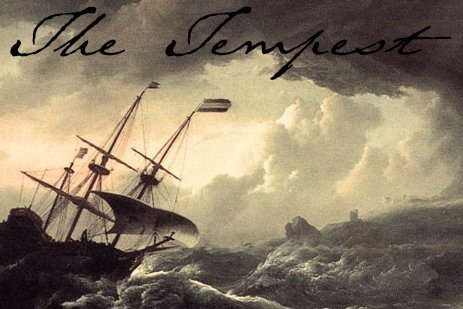
THE TEMPEST ACT 1 SCENE 1
A violent
storm rages around a small ship at sea. The master of the ship calls for his
boatswain to rouse the mariners to action and prevent the ship from being run
aground by the tempest. Chaos ensues. Some mariners enter, followed by a group
of nobles comprised of Alonso, King of Naples, Sebastian, his brother, Antonio,
Gonzalo, and others. We do not learn these men’s names in this scene, nor do we
learn (as we finally do in Act II, scene i) that they have just come from
Tunis, in Africa, where Alonso’s daughter, Claribel, has been married to the
prince. As the Boatswain and his crew take in the topsail and the topmast,
Alonso and his party are merely underfoot, and the Boatswain tells them to get
below-decks. Gonzalo reminds the Boatswain that one of the passengers is of
some importance, but the Boatswain is unmoved. He will do what he has to in
order to save the ship, regardless of who is aboard.
The lords
go below decks, and then, adding to the chaos of the scene, three of
them—Sebastian, Antonio, and Gonzalo—enter again only four lines later.
Sebastian and Antonio curse the Boatswain in his labors, masking their fear
with profanity. Some mariners enter wet and crying, and only at this point does
the audience learn the identity of the passengers on-board. Gonzalo orders the
mariners to pray for the king and the prince. There is a strange noise—perhaps
the sound of thunder, splitting wood, or roaring water—and the cry of mariners.
Antonio, Sebastian, and Gonzalo, preparing to sink to a watery grave, go in
search of the king.
QUESTIONS
1. Who was in charge of the ship during the storm at sea?
2.
Why did Alonso, the king, interfere with the Boatswain’s work in securing the
ship during the storm?
3.
Where did the Boatswain tell the king and his courtiers to go?
4.
Who were the first to go to their cabins below the top deck?
5.
What joke does Gonzalo tell concerning the Boatswain?
6.
How does this joke affect the rest of the passengers and crew?
7.
How do Sebastian and Antonio react to the Boatswain?
8.
How does the Boatswain respond to Sebastian’s and Antonio’s insulting remarks?
9.
How does Antonio decide to die in the storm at sea?
10.
How loyal is Sebastian to his brother, the king?
Tuesday, April 12, 2016
introduction to persuasion
A. Persuasion
aims at convincing the reader/listener/viewer more through emotional appeal
than through valid reasons of a product, concept, practice or idea. There are
several different media through which persuasion is done – verbally or in
writing.
Examples:
i.
Letters to the editor
ii.
Speeches, debates etc.
iii.
Advertisements
B.
Speech writing is an art
of conveying a message to your audience. Either through oral communication or
through other means, such as PowerPoint slides, speech writing has the same
function as normal writing. The reasons for writing are to inform, to explain
or to persuade. In a speech, typically the main purpose is to persuade the
listener/reader to take up and support your views. What can differentiate a
speech from a normal essay is that your audience can be from all sorts of
backgrounds.
Main
Techniques used in Persuasion (Writing of Essays, Speeches and Ads)
a) A
Specific Font and Font Size
b) Use
of Figures (Statistics)
c) Use
of celebrities or relatable characters
d) Pictures
e) Wit
and Humour
f) Bribery
g) Testimonials
h) Appeal
to Emotion
i)
Appeal to Logic
j)
Use of Repetition
k) Use
of Rhetorical Questions
l)
Authoritative Evidence
m) Statistical
Proof or Research
https://youtu.be/D9BVEnEsn6Y
Elements of drama
Playwright – The person who writes the
play. (Comes from an old English idiom in which “wright” meant “maker of”
·
The conflict underlies every play. It is the key issue around which the
plot/ storyline is developed using specific persons (characters), during a clear time frame (time) and it must take place somewhere (setting)
·
Act – A major division in a play. In an
act there is a major development that usually begins and moves to a climax,
which leads to other things happening in other acts.
·
There are also one act plays in
which everything occurs in that one act. (similar to short story vs. novel)
·
Scene- This is generally a subdivision
of an act. Whenever people go on stage and change the setting, the scene has
been changed. Therefore scene refers to a specific development that takes place
at a specific point in time.
·
Dialogue- This refers to the
conversation between two or more characters in a play
·
Monologue – A monologue occurs when one
actor is on stage thinking aloud
Introduce
students to the term soliloquy.
·
A Soliloquy help to thicken the plot, it
leads the audience into the mind of the character and allows the audience to be
able to “read into” the actor/ actress’ motivations for his / her actions.
·
Stage directions - These are the notes put into the script by
the playwright to tell the actor or director what to do.
· Script – This refers to the text of the
play, ie The book the actor reads to study his / her lines
·
Lines – These are the words that the
writer has written for the actor and actresses to speak.
·
Props – short for stage properties,
Items that are used by actors on stage.
Elements of drama assignment
Please watch the following video:
https://www.youtube.com/watch?v=O-11YWAUdbg
Identify as many elements of drama as possible.
Make a note of them in your notebook.
https://www.youtube.com/watch?v=O-11YWAUdbg
Identify as many elements of drama as possible.
Make a note of them in your notebook.
Tuesday, March 22, 2016
GRADED ASSIGNMENTS FOR EASTER TERM
LANGUAGE
- Clauses (from the Grammar Plus) *collected and marked already
- Descriptive essay (Describe your aunt from New York) *collected and marked already
- Story/Setting (English for All 3, pg. 68, ex. 2.1)
- Comprehension (English for All 3, pg. 137, #1-10)
LITERATURE
- Essay ("Little Boy Crying" and "My Parents") *posted earlier on the blog
- Matching phrases and comprehension ("Once Upon a Time")
- Comprehension questions ("My Parents")*posted earlier on the blog
- Comprehension questions ("The Woman Speaks to the Man...")
Subscribe to:
Posts (Atom)
